GFCI vs AFCI: what it means for the Texas exam
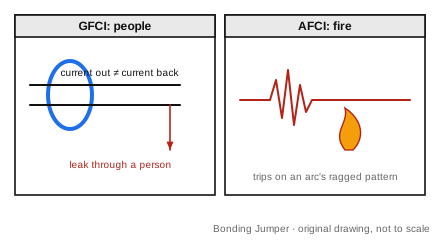
A ground-fault circuit interrupter, or GFCI, protects people from shock: it trips when the current going out on the hot conductor and the current returning on the neutral differ by a few milliamperes. An arc-fault circuit interrupter, or AFCI, protects against fire: it watches the current's waveform for the signature of a dangerous arc and trips when it finds one.
Use this diagram
How a GFCI senses a fault
Both circuit conductors pass through a sensing coil. Normally the current out equals the current back, and their magnetic fields cancel. If some current leaks to ground, perhaps through a person, the difference produces a signal and the device opens the circuit within a fraction of a second. The Class A devices used to protect people are built to trip at roughly 4 to 6 milliamperes, far below what a breaker notices. A GFCI does not need an equipment ground to work, which is why it is allowed as a replacement for an old ungrounded receptacle with the proper marking.
Check where you stand on TX Journeyman
Scored by domain, untimed. No signup.
Start the free 10-question checkHow an AFCI senses a fault
Arcs from a nicked cord, a loose connection or a nail through a cable produce current with a ragged, high-frequency pattern. An AFCI's electronics look for that pattern and trip before the arc heats nearby material enough to ignite it. A combination AFCI detects arcs between conductors and arcs along a single damaged conductor. An AFCI is not designed to detect a small leak to ground the way a GFCI is.
Ask Lug before you buy AI your Bonding Jumper study buddy
See what's on the TX Journeyman exam, test yourself with 5 quick questions, or find the plan that fits you.
The TX Journeyman course
Available now · instant accessLearn the subject areas the exam tests most, then prove it on timed practice exams in the two-portion format.
- 10modules of lessonsEvery task on the outline
- 3full-length timed exams80 questions in 240 minutes each
- 411practice questionsEach one explained
- 1week-by-week study planSet to your exam date
Turn a practice answer into a study step. In untimed practice, ask Lug AI about any question you answer, follow up, then see your weakest topics and what to drill next.
Instant access. Terms and refunds · Secure checkout by Stripe · Billed by Nori Software
Every answer comes with a full explanation.
Where the NEC requires them
Article 210 holds the main requirements. GFCI protection is required in places where water and grounded surfaces raise the shock risk, such as bathrooms, kitchens, outdoors, garages and basements, among others. AFCI protection is required for many branch circuits supplying living areas in dwellings. The lists change between editions, so read them in your own 2026 NEC rather than from memory.
Dual-function devices combine both in one breaker or receptacle. Ground-fault protection of equipment is a different thing again: it trips at much higher currents to protect equipment from damaging ground faults, not people.
Common mix-ups
- Thinking either one replaces overcurrent protection. A receptacle-type GFCI or AFCI does not protect the circuit from overload. See overcurrent protection.
- Assuming a GFCI protects against line-to-neutral shock. Current that goes out and comes back through a person between the two conductors is balanced.
- Thinking a GFCI needs a ground to work. It does not, though the equipment grounding path still matters for clearing faults. See bonding vs grounding.
On the Texas journeyman exam
GFCI and AFCI requirements sit in branch circuits and conductors, 14 scored items across both portions under the PSI bulletin, and in special occupancies for pools, health care and similar locations. Study to find where protection is required with the book open.
Practice it
The exam outline shows how many items each area carries. Every term in this set is in the electrical terms glossary.
Know the terms? Take the free 10-question check
Take the free 10-question check. It needs no signup and explains every answer, so you see whether theory, grounding or wiring methods costs you the most points. When you want the full method worked topic by topic, the Bonding Jumper course comes second.
Not affiliated with or endorsed by TDLR, PSI or NFPA. NEC and National Electrical Code are registered trademarks of NFPA.
Sources
Show the list
- Candidate Information Bulletin, Texas electricians (updated 9/15/2026), PSI for the Texas Department of Licensing and Regulation.
- NFPA 70, National Electrical Code (2026 edition), NFPA. Free read-only access with an account.
Facts checked 26 October 2026 against the sources listed above. If something has changed, tell us and we will correct it within 2 business days.
Your next step
Ready to see where you stand on TX Journeyman?
Free, untimed and scored by domain. No signup.
Start the free 10-question checkTexas Journeyman course. Lessons, timed practice exams and a plan around your exam date. Get Texas Journeyman course · $99 See the plans or read the free sample lesson.Terms and refunds
Want a timed run? Try the free 25-question mini-mock. The first 5 need no email.
Prefer paper? Free printables
- Print a class quiz (free PDF). 5 practice questions with an answer key on page 2.
- Print the flashcards as cut-out cards (free PDF). The free flashcard sample, ready to cut and carry.
From the blog
- Texas Journeyman Study Plan Built on the Exam Weights
- Ohm's Law and Power Formulas for the Electrician Exam
- How to Become a Journeyman Electrician in Texas