Raceway: what it means for the Texas exam
A raceway is an enclosed channel, made of metal or nonmetallic material, designed specifically to hold wires, cables or busbars. Conduit, electrical metallic tubing, flexible conduit and wireways are raceways. The conductors are pulled into the raceway after it is installed, and the raceway protects them and can be opened up or rewired later.
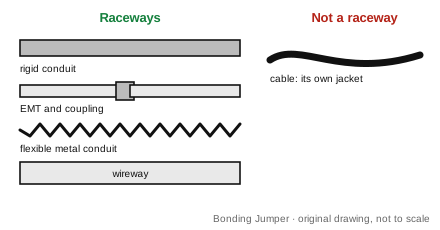
Use this diagram
Common raceway types
- Rigid metal conduit and intermediate metal conduit: threaded, heavy-wall steel or aluminum, for the most physical protection.
- Electrical metallic tubing: thin-wall steel joined with set-screw or compression fittings; a widely used raceway.
- Rigid PVC conduit: nonmetallic, resistant to corrosion, common underground.
- Flexible metal conduit and liquidtight flexible conduit: for connections to motors and vibrating equipment.
- Wireways and surface raceways: troughs with removable covers.
Each type has its own NEC article covering where it may be used, how it is supported and how many bends are allowed between pull points.
Check where you stand on TX Journeyman
Scored by domain, untimed. No signup.
Start the free 10-question checkWhat does not count
- Cable. Nonmetallic-sheathed cable and metal-clad cable have their own jacket or armor around factory-installed conductors. They are cable assemblies, not raceways.
The easy way to tell them apart is to ask where the conductors come from. In a raceway you pull separate conductors in after the enclosure is up. In a cable they arrive already assembled inside their own covering.
Ask Lug before you buy AI your Bonding Jumper study buddy
See what's on the TX Journeyman exam, test yourself with 5 quick questions, or find the plan that fits you.
The TX Journeyman course
Available now · instant accessLearn the subject areas the exam tests most, then prove it on timed practice exams in the two-portion format.
- 10modules of lessonsEvery task on the outline
- 3full-length timed exams80 questions in 240 minutes each
- 411practice questionsEach one explained
- 1week-by-week study planSet to your exam date
Turn a practice answer into a study step. In untimed practice, ask Lug AI about any question you answer, follow up, then see your weakest topics and what to drill next.
Instant access. Terms and refunds · Secure checkout by Stripe · Billed by Nori Software
Every answer comes with a full explanation.
Why the distinction matters
Several rules apply only to raceways, and several apply only to cables. Conduit fill, the share of a raceway's cross-section conductors may take, uses the Chapter 9 tables. A metal raceway can serve as the equipment grounding conductor under Article 250 when its fittings keep it continuous; see EGC vs GEC. The conductor insulation types you pull in depend on whether the raceway is in a wet location, and the raceway ends in boxes whose box fill you must check.
Common mix-ups
- Calling MC cable a raceway. Its armor is part of the cable.
- Assuming PVC can be the ground path. A nonmetallic raceway needs a separate equipment grounding conductor.
- Forgetting that underground raceways are wet locations inside, so the conductors must be rated for wet use.
On the Texas journeyman exam
Raceways sit in wiring methods and materials, 12 scored items across both portions under the PSI bulletin. Study to find where a raceway type may be used, how it is supported, and how many conductors fit.
Practice it
The conduit fill guide walks through the Chapter 9 tables and Annex C. Every term in this set is in the electrical terms glossary.
Know the terms? Take the free 10-question check
Take the free 10-question check. It needs no signup and explains every answer, so you see whether theory, grounding or wiring methods costs you the most points. When you want the full method worked topic by topic, the Bonding Jumper course comes second.
Not affiliated with or endorsed by TDLR, PSI or NFPA. NEC and National Electrical Code are registered trademarks of NFPA.
Sources
Show the list
- Candidate Information Bulletin, Texas electricians (updated 9/15/2026), PSI for the Texas Department of Licensing and Regulation.
- NFPA 70, National Electrical Code (2026 edition), NFPA. Free read-only access with an account.
Facts checked 26 October 2026 against the sources listed above. If something has changed, tell us and we will correct it within 2 business days.
Your next step
Ready to see where you stand on TX Journeyman?
Free, untimed and scored by domain. No signup.
Start the free 10-question checkTexas Journeyman course. Lessons, timed practice exams and a plan around your exam date. Get Texas Journeyman course · $99 See the plans or read the free sample lesson.Terms and refunds
Want a timed run? Try the free 25-question mini-mock. The first 5 need no email.
Prefer paper? Free printables
- Print a class quiz (free PDF). 5 practice questions with an answer key on page 2.
- Print the flashcards as cut-out cards (free PDF). The free flashcard sample, ready to cut and carry.
From the blog
- 2023 or 2026 NEC? The Code Book for the Texas Exam
- How to Find Answers Fast in the NEC on an Open-Book Exam
- The Continuous Load 125% Rule Explained for Electricians