Ampacity: what it means for the Texas exam
Ampacity is the largest current, in amperes, that a conductor can carry continuously under its conditions of use without its temperature rising past what its insulation is rated for. It is not a property of the copper alone. The same wire has a different ampacity in a hot attic, in a crowded raceway or in free air.
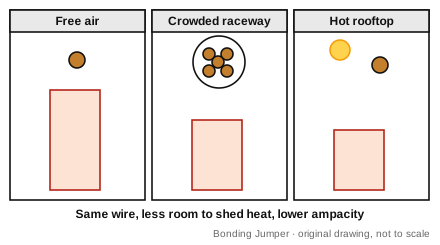
Use this diagram
Heat is the real limit
Current through any conductor makes heat, in proportion to the square of the current and the conductor's resistance. The conductor gets rid of that heat into its surroundings. Ampacity is the current at which heat in balances heat out at the insulation's temperature rating. Exceed it for long and the insulation ages, cracks and eventually fails.
So anything that makes it harder to shed heat lowers ampacity: a higher surrounding temperature, more current-carrying conductors bundled together, or a raceway in direct sunlight on a roof. Anything that helps lowers the temperature rise: a larger conductor, free air, wider spacing.
Check where you stand on TX Journeyman
Scored by domain, untimed. No signup.
Start the free 10-question checkHow the NEC handles it
Article 310 gives tables of ampacity by conductor size, material and insulation temperature column, under stated base conditions. Real installations rarely match the base conditions, so the code gives correction factors for ambient temperature and adjustment factors for more than three current-carrying conductors together. The table value times the factors is the adjusted ampacity. We do not reproduce the table values here; work them from your own 2026 NEC.
The insulation's temperature rating decides which column you may start in, and the terminal rating of the equipment can limit the final answer to a lower column. That is why the conductor insulation types page matters to ampacity.
Ask Lug before you buy AI your Bonding Jumper study buddy
See what's on the TX Journeyman exam, test yourself with 5 quick questions, or find the plan that fits you.
The TX Journeyman course
Available now · instant accessLearn the subject areas the exam tests most, then prove it on timed practice exams in the two-portion format.
- 10modules of lessonsEvery task on the outline
- 3full-length timed exams80 questions in 240 minutes each
- 411practice questionsEach one explained
- 1week-by-week study planSet to your exam date
Turn a practice answer into a study step. In untimed practice, ask Lug AI about any question you answer, follow up, then see your weakest topics and what to drill next.
Instant access. Terms and refunds · Secure checkout by Stripe · Billed by Nori Software
Every answer comes with a full explanation.
Ampacity on one side, load on the other
A sizing problem compares two numbers. The required current is the load, raised to 125 percent for a continuous load. The available current is the conductor's adjusted ampacity. The conductor works when the available meets or exceeds the required. Keeping the factors on the right side of that comparison prevents errors.
Common mix-ups
- Using the 90-degree column for the final answer when the terminals are rated lower.
- Applying correction factors to the load. They reduce the conductor's ampacity, not raise the load.
- Counting the equipment grounding conductor as current-carrying. It is not, for adjustment.
- Confusing ampacity with breaker size. The breaker protects the conductor; the two are related, not the same.
On the Texas journeyman exam
Ampacity runs through the branch circuits and conductors area, 14 scored items across both portions under the PSI bulletin, the largest area, and feeds feeder, motor and service problems too.
Practice it
The conductor ampacity guide works correction and adjustment step by step with the 2026 NEC open. Every term in this set is in the electrical terms glossary.
Know the terms? Take the free 10-question check
Take the free 10-question check. It needs no signup and explains every answer, so you see whether theory, grounding or wiring methods costs you the most points. When you want the full method worked topic by topic, the Bonding Jumper course comes second.
Not affiliated with or endorsed by TDLR, PSI or NFPA. NEC and National Electrical Code are registered trademarks of NFPA.
Sources
Show the list
- Candidate Information Bulletin, Texas electricians (updated 9/15/2026), PSI for the Texas Department of Licensing and Regulation.
- NFPA 70, National Electrical Code (2026 edition), NFPA. Free read-only access with an account.
Facts checked 26 October 2026 against the sources listed above. If something has changed, tell us and we will correct it within 2 business days.
Your next step
Ready to see where you stand on TX Journeyman?
Free, untimed and scored by domain. No signup.
Start the free 10-question checkTexas Journeyman course. Lessons, timed practice exams and a plan around your exam date. Get Texas Journeyman course · $99 See the plans or read the free sample lesson.Terms and refunds
Want a timed run? Try the free 25-question mini-mock. The first 5 need no email.
Prefer paper? Free printables
- Print a class quiz (free PDF). 5 practice questions with an answer key on page 2.
- Print the flashcards as cut-out cards (free PDF). The free flashcard sample, ready to cut and carry.
From the blog
- Texas Journeyman Exam Passing Score: 70% on Each Portion
- Transformer Calculations: kVA to Amps for Electricians
- Texas Journeyman vs Master Electrician Exam Differences