Power factor: what it means for the Texas exam
Power factor is the ratio of true power, in watts, to apparent power, in volt-amperes. It tells you how much of the current a load draws is actually doing work. A power factor of 1.0 means voltage and current rise and fall together. Motors and other inductive loads pull the two out of step.
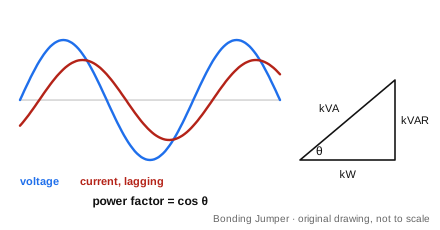
Use this diagram
Where it comes from
In a purely resistive load, such as a heater, current and voltage peak together, and every volt-ampere becomes a watt. Inductance, in motors, transformers and ballasts, stores energy in a magnetic field and returns it each cycle, which delays the current behind the voltage. Capacitance does the opposite and pushes current ahead. The energy that sloshes back and forth is reactive power, measured in VAR. It does no work but still flows in the conductors.
Power factor equals the cosine of the angle between voltage and current. It also equals the circuit's resistance divided by its impedance.
Check where you stand on TX Journeyman
Scored by domain, untimed. No signup.
Start the free 10-question checkWhy low power factor costs
For the same true power, a lower power factor means more current. A worked example with invented numbers: a single-phase 240-volt load uses 8 kW.
- At a power factor of 1.0, apparent power is 8 kVA, and current is 8,000 ÷ 240 = about 33.3 amperes.
- At a power factor of 0.8, apparent power is 8 ÷ 0.8 = 10 kVA, and current is 10,000 ÷ 240 = about 41.7 amperes.
The second load does the same work and draws about 25% more current. That current heats conductors, adds voltage drop and uses up transformer capacity. It is also why utilities charge some large customers for low power factor.
Ask Lug before you buy AI your Bonding Jumper study buddy
See what's on the TX Journeyman exam, test yourself with 5 quick questions, or find the plan that fits you.
The TX Journeyman course
Available now · instant accessLearn the subject areas the exam tests most, then prove it on timed practice exams in the two-portion format.
- 10modules of lessonsEvery task on the outline
- 3full-length timed exams80 questions in 240 minutes each
- 411practice questionsEach one explained
- 1week-by-week study planSet to your exam date
Turn a practice answer into a study step. In untimed practice, ask Lug AI about any question you answer, follow up, then see your weakest topics and what to drill next.
Instant access. Terms and refunds · Secure checkout by Stripe · Billed by Nori Software
Every answer comes with a full explanation.
Fixing it
Capacitors installed near inductive loads supply the reactive current locally, so less of it travels from the source. That is power factor correction. Synchronous motors and some drives can do the same job.
Common mix-ups
- Watts and volt-amperes are not interchangeable. They match only at a power factor of 1.0. See apparent vs true power.
- Using power factor to size a transformer. Transformers are rated in kVA, which already includes it.
- Power factor above 1.0. It cannot be; the ratio tops out at 1.
On the Texas journeyman exam
Power factor belongs to definitions, theory and plans, a small area of 5 scored items across both portions under the PSI bulletin, and appears inside motor and load calculations. Study to convert between watts, volt-amperes and current with a given power factor.
Practice it
The Ohm's law calculator works the power formulas, including three-phase. Every term in this set is in the electrical terms glossary.
Know the terms? Take the free 10-question check
Take the free 10-question check. It needs no signup and explains every answer, so you see whether theory, grounding or wiring methods costs you the most points. When you want the full method worked topic by topic, the Bonding Jumper course comes second.
Not affiliated with or endorsed by TDLR, PSI or NFPA. NEC and National Electrical Code are registered trademarks of NFPA.
Sources
Show the list
- Candidate Information Bulletin, Texas electricians (updated 9/15/2026), PSI for the Texas Department of Licensing and Regulation.
- NFPA 70, National Electrical Code (2026 edition), NFPA. Free read-only access with an account.
Facts checked 26 October 2026 against the sources listed above. If something has changed, tell us and we will correct it within 2 business days.
Your next step
Ready to see where you stand on TX Journeyman?
Free, untimed and scored by domain. No signup.
Start the free 10-question checkTexas Journeyman course. Lessons, timed practice exams and a plan around your exam date. Get Texas Journeyman course · $99 See the plans or read the free sample lesson.Terms and refunds
Want a timed run? Try the free 25-question mini-mock. The first 5 need no email.
Prefer paper? Free printables
- Print a class quiz (free PDF). 5 practice questions with an answer key on page 2.
- Print the flashcards as cut-out cards (free PDF). The free flashcard sample, ready to cut and carry.
From the blog
- How to Find Answers Fast in the NEC on an Open-Book Exam
- Texas Electrician License Reciprocity: States and Steps
- Failed One Portion of the Texas Journeyman Exam? Next Steps