Wye vs delta: what it means for the Texas exam
Wye and delta are the two ways to connect the three windings of a three-phase transformer or motor. In a wye, one end of each winding meets at a common center point, which can serve as a neutral. In a delta, the windings form a closed triangle with the lines at the corners, so there is no natural center point.
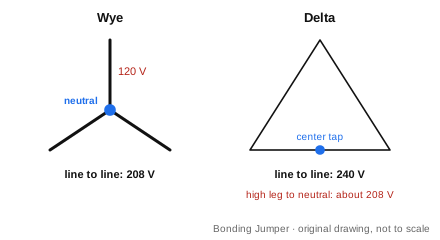
Use this diagram
Voltages and currents
Wye. Each winding sits between a line and the neutral, so the phase voltage is line to neutral. The line-to-line voltage is 1.732 times the phase voltage: 120 × 1.732 is about 208, and 277 × 1.732 is about 480. The line current equals the winding current. That is why a 208Y/120 or 480Y/277 system gives two voltages, one for lighting and receptacles and one for motors.
Delta. Each winding sits directly between two lines, so the line voltage equals the winding voltage. The line current is 1.732 times the winding current, because each line is fed by two windings. A plain delta has no neutral.
Check where you stand on TX Journeyman
Scored by domain, untimed. No signup.
Start the free 10-question checkThe high-leg delta
A common older service is a 240-volt delta with one winding center-tapped to make a neutral, giving 120/240 volts for single-phase loads from two of the phases. The third phase, measured to that neutral, reads about 208 volts. It is the high leg, sometimes called the wild leg. The NEC requires it to be identified, by an orange finish or another effective marking, and it cannot serve 120-volt loads. Panel position rules apply to it too; find them in your own 2026 NEC.
Ask Lug before you buy AI your Bonding Jumper study buddy
See what's on the TX Journeyman exam, test yourself with 5 quick questions, or find the plan that fits you.
The TX Journeyman course
Available now · instant accessLearn the subject areas the exam tests most, then prove it on timed practice exams in the two-portion format.
- 10modules of lessonsEvery task on the outline
- 3full-length timed exams80 questions in 240 minutes each
- 411practice questionsEach one explained
- 1week-by-week study planSet to your exam date
Turn a practice answer into a study step. In untimed practice, ask Lug AI about any question you answer, follow up, then see your weakest topics and what to drill next.
Instant access. Terms and refunds · Secure checkout by Stripe · Billed by Nori Software
Every answer comes with a full explanation.
Where each shows up
- Wye is the usual building distribution system, because the neutral serves single-phase loads and makes grounding straightforward.
- Delta is common on transformer primaries, on some industrial systems and in motors. A delta-wye transformer, with a delta primary and a wye secondary, is a standard way to create a 208Y/120 system from a 480-volt supply.
Common mix-ups
- Using 1.732 in the wrong place. In a wye it relates voltages; in a delta it relates currents.
- Connecting 120-volt loads to the high leg. The high leg to neutral is about 208 volts.
- Thinking a delta cannot be grounded. It can be, at a corner or a center tap; it simply has no natural neutral.
- Mixing up phase and line values in a formula. The three-phase power formula uses line voltage and line current. See single-phase vs three-phase.
On the Texas journeyman exam
System connections sit in definitions, theory and plans and in the services and separately derived systems area, which together carry 15 scored items across both portions under the PSI bulletin. Study to find a voltage or current in either connection and to recognise a high-leg system.
Practice it
The transformer calculator works three-phase kVA to amperes on each side. See transformer kVA for the rating itself. Every term in this set is in the electrical terms glossary.
Know the terms? Take the free 10-question check
Take the free 10-question check. It needs no signup and explains every answer, so you see whether theory, grounding or wiring methods costs you the most points. When you want the full method worked topic by topic, the Bonding Jumper course comes second.
Not affiliated with or endorsed by TDLR, PSI or NFPA. NEC and National Electrical Code are registered trademarks of NFPA.
Sources
Show the list
- Candidate Information Bulletin, Texas electricians (updated 9/15/2026), PSI for the Texas Department of Licensing and Regulation.
- NFPA 70, National Electrical Code (2026 edition), NFPA. Free read-only access with an account.
Facts checked 26 October 2026 against the sources listed above. If something has changed, tell us and we will correct it within 2 business days.
Your next step
Ready to see where you stand on TX Journeyman?
Free, untimed and scored by domain. No signup.
Start the free 10-question checkTexas Journeyman course. Lessons, timed practice exams and a plan around your exam date. Get Texas Journeyman course · $99 See the plans or read the free sample lesson.Terms and refunds
Want a timed run? Try the free 25-question mini-mock. The first 5 need no email.
Prefer paper? Free printables
- Print a class quiz (free PDF). 5 practice questions with an answer key on page 2.
- Print the flashcards as cut-out cards (free PDF). The free flashcard sample, ready to cut and carry.
From the blog
- Texas Journeyman vs Master Electrician Exam Differences
- The Continuous Load 125% Rule Explained for Electricians
- Ohm's Law and Power Formulas for the Electrician Exam