Feeder vs branch circuit: what it means for the Texas exam
A feeder is any set of circuit conductors between the service equipment, or another source such as a transformer, and the final overcurrent device of a branch circuit. A branch circuit is the set of conductors from that final overcurrent device to the outlets it serves. The last breaker or fuse before the load marks the line.
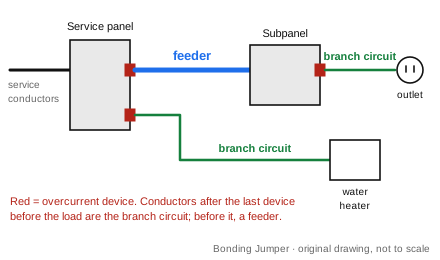
Use this diagram
Find the last overcurrent device
Walk the circuit backward, from the load toward the source. The first breaker or fuse you reach protects the branch circuit, and every conductor on its load side is branch circuit wiring. Every conductor on its supply side, back to the service or the source, is feeder. A run from the service panel to a subpanel is a feeder, because more overcurrent devices sit at its far end. A run from that same service panel straight to a water heater is a branch circuit, because nothing else protects it before the load. Where the panel sits does not decide the name. The device does.
Why the name matters
- Different articles. Branch circuits are in Article 210 and feeders are in Article 215, and the terms themselves are defined in Article 100. A question that says feeder sends you to a different article from one that says branch circuit. Protection for either sits under Article 240; see overcurrent protection.
- Different sizing. A feeder carries the combined calculated load of everything downstream of it, so it is sized from a load calculation. A branch circuit is sized for the load it serves. Both have to allow for a continuous load.
- Different voltage drop budgets. The voltage drop recommendations in the NEC sit in informational notes and treat feeders and branch circuits separately, so you need to know which run you are checking. Work a run of each kind in the voltage drop calculator and compare.
Check where you stand on TX Journeyman
Scored by domain, untimed. No signup.
Start the free 10-question checkA worked example
The numbers are invented. A shop's main panel has a 100 A breaker feeding a subpanel across the building. In the subpanel, a 20 A breaker feeds four receptacles on a workbench. Back in the main panel, a 30 A two-pole breaker feeds a water heater directly.
- Main panel to subpanel: feeder. It ends at a panel full of overcurrent devices.
- Subpanel 20 A breaker to the receptacles: branch circuit.
- Main panel 30 A breaker to the water heater: branch circuit, even though it starts in the main panel.
If the owner later adds a second subpanel fed from the first one, the conductors between the two subpanels are a feeder too.
Common mix-ups
- Calling every run from the main panel a feeder. A circuit from the main panel straight to a load is a branch circuit.
- Calling a big circuit a feeder because it is big. A heavy circuit to a single piece of equipment is still a branch circuit when no overcurrent device sits between its breaker and the load.
- Treating service conductors as a feeder. The conductors from the utility to the service disconnect are service conductors, which have their own article.
- Forgetting a transformer can start a feeder. The conductors leaving a transformer for the panel it supplies are feeder conductors. See separately derived system.
On the Texas journeyman exam
Under the PSI bulletin, electrical feeders carry 6 scored items across both portions, 3 on NEC Knowledge and 3 on Calculations. Branch circuits and conductors carry 14, 10 and 4, the most of any subject area. Feeder load calculations, feeder overcurrent protection, and feeder grounded conductors and grounding and bonding are listed under feeders. Study to name each run first, then pick the article and the calculation that goes with it.
Sitting a master exam on the 2023 NEC outside Texas? Start with the master electrician exam outline or take the free NEC master check.
Practice it
Every term in this set is in the electrical terms glossary.
Know the terms? Take the free 10-question check
Take the free 10-question check. It needs no signup and explains every answer, so you see whether theory, grounding or wiring methods costs you the most points. When you want the full method worked topic by topic, the Bonding Jumper course comes second.
Not affiliated with or endorsed by TDLR, PSI or NFPA. NEC and National Electrical Code are registered trademarks of NFPA.
Ask Lug before you buy AI your AI study assistant
See what's on the TX Journeyman exam, test yourself with 5 quick questions, or find the plan that fits you.
The TX Journeyman course
Available now · instant accessLearn the subject areas the exam tests most, then prove it on timed practice exams in the two-portion format.
- 10modules of lessonsEvery task on the outline
- 3timed practice exams80 scored questions, 240 minutes; exam day adds 5 unscored
- 442practice questionsEach one explained
- 1week-by-week study planSet to your exam date
Turn a practice answer into a study step. In untimed practice, ask Lug AI about any question you answer, follow up, then see your weakest topics and what to drill next.
Instant access. Terms and refunds · Secure checkout by Stripe · Billed by Nori Software
Every answer comes with a full explanation.
Sources
Show the list
- Candidate Information Bulletin, Texas electricians (updated 9/15/2026), PSI for the Texas Department of Licensing and Regulation. Checked 14 Nov 2026.
- NFPA 70, National Electrical Code (2026 edition), NFPA. Free read-only access with an account. Checked 14 Nov 2026.
Bonding Jumper editorial team
Facts come from the sources listed above. If something has changed, tell us and we will correct it.
Your next step
Ready to see where you stand on TX Journeyman?
Free, untimed and scored by domain. No signup.
Start the free 10-question checkTexas Journeyman course. Lessons, timed practice exams and a plan around your exam date. Get Texas Journeyman course · $99 See the plans or read the free sample lesson.Terms and refunds
Want a timed run? Take the free 25-question practice test (about 71 minutes). No email needed.
Prefer paper? Free printables
- Print a class quiz (free PDF). 5 practice questions with an answer key on page 2.
- Print the flashcards as cut-out cards (free PDF). The free flashcard sample, ready to cut and carry.
From the blog
- Texas Journeyman Exam Time Management for Both Portions
- Texas Electrician Exam Calculator: What Is Allowed
- Texas Journeyman Study Plan Built on the Exam Weights