Standard vs optional load calculation: what it means for the Texas exam
A load calculation turns the loads in a building into the volt-amperes a service or feeder must carry. The standard method takes each group of loads through its own rule and demand step, then adds the results. The optional method, written for particular occupancies such as a dwelling, adds most loads into one total and applies one stepped demand.
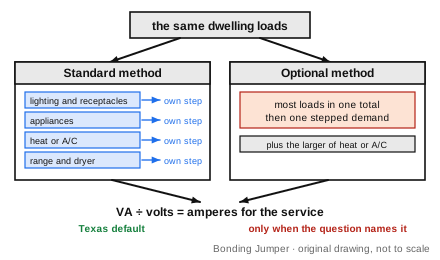
Use this diagram
How each method works
A demand factor is an allowance for the fact that the loads in a building do not all run at full power at the same time. Both methods use demand factors. They differ in how many separate steps they take.
- Standard method. You work the load group by group: general lighting and receptacles, small appliances and laundry, fixed appliances, cooking, drying, heating or cooling, and motors. Each group follows its own rule, and some groups get their own demand step. You add the results for the total. It is the default route.
- Optional method. You add most of the loads into one total, apply a single stepped demand to that total, and add the larger of the heating or the cooling load. There are fewer steps, and on the same house it can give a different number from the standard method.
Either way, the last step is the same: divide the total volt-amperes by the voltage for single-phase, or by the voltage × 1.732 for three-phase, to get the current that sizes the service or feeder.
Which one the Texas exam expects
The PSI Candidate Information Bulletin for Texas electricians (updated 9/15/2026) tells candidates not to consider code exceptions or optional calculation methods unless a question specifically directs them to. So the standard method is your default. Switch to the optional method only when the question names it. If the question says nothing about a method, an answer worked by the optional method is a distractor, even when the arithmetic behind it is right.
Under the same bulletin, load calculations sit in services, service equipment and separately derived systems, an area worth 8 scored items in the master Calculations portion and 4 in the journeyman one. Feeder load calculations sit under feeders, worth 3 scored items in each. The master Calculations portion guide works a full feeder load.
Try one question
Question 1 of the free 10-question check on TX Master. No signup. Then ask Lug, the AI study assistant, why the answer is right and the others are wrong.
Electrical Wiring Methods and Electrical Materials
Four conductors of the same size and insulation are pulled into a 20-ft run of conduit. What is the maximum percentage of the conduit's cross-sectional area they may fill?
Press A-D or 1-4 to choose an answer while this question is on screen.
Choose an answer to begin
Where the methods sit in your NEC
In the 2023 NEC, load calculations are Article 220, with the standard calculations in Part III and the optional calculations in Part IV. The 2026 edition moved load calculations out of Article 220, and the Texas exam uses the 2026 NEC, so find where your own book puts both parts and tab each one. Never carry a 2023 part number into a 2026 book.
A worked example with invented numbers
These step values are invented for practice, not the ones in your book. A question gives a dwelling with 30 kVA of loads on a 120/240 volt single-phase service, tells you to use the optional method, and gives the step as stated inputs: the first 12 kVA at 100% and the rest at 50%.
- Split the total: 30 - 12 = 18 kVA above the first step.
- Apply the step: 18 x 0.5 = 9 kVA.
- Add the first step back: 12 + 9 = 21 kVA, or 21,000 VA.
- Current: 21,000 ÷ 240 = 87.5 amperes.
Skip the demand step and you get 30,000 ÷ 240 = 125 amperes, a different answer choice. Had the question not named the optional method, you would work the same house by the standard method, group by group.
Common mix-ups
- Reaching for the optional method because it is shorter. On the Texas exam it is out unless the question names it.
- Mixing steps from both methods. Pick one route and finish it.
- Treating 125% as a demand factor. A demand factor lowers a total because not everything runs at once. The 125% for a continuous load raises the continuous part because heat builds over hours. They answer different questions.
- Sizing the neutral from the service total. The neutral conductor carries only the unbalanced current, so it has its own load figure.
- Using 1.732 on a single-phase service. Only three-phase divides by the voltage × 1.732.
Practice it
The electrical calculations practice drills the arithmetic around a load calculation, from power and current to continuous plus noncontinuous loads, with every step shown. Every term in this set is in the electrical terms glossary.
Sitting a master exam on the 2023 NEC outside Texas? Start with the master electrician exam outline or take the free NEC master check.
Know the methods? Take the free 10-question check
Take the free 10-question check for the Texas master exam. It needs no signup and explains every answer, so you see whether load calculations, motors or grounding cost you the most points.
Not affiliated with or endorsed by TDLR, PSI or NFPA. NEC and National Electrical Code are registered trademarks of NFPA.
Ask Lug before you buy AI your AI study assistant
See what's on the TX Master exam, test yourself with 5 quick questions, or find the plan that fits you.
The TX Master course
Available now · instant accessLearn the subject areas the exam tests most, then prove it on a timed practice exam in the two-portion format.
- 10modules of lessonsEvery task on the outline
- 1timed practice exams72 questions in 232 minutes
- 192practice questionsEach one explained
- 1week-by-week study planSet to your exam date
Turn a practice answer into a study step. In untimed practice, ask Lug AI about any question you answer, follow up, then see your weakest topics and what to drill next.
Instant access. Terms and refunds · Secure checkout by Stripe · Billed by Nori Software
Every answer comes with a full explanation.
Sources
Show the list
- Candidate Information Bulletin, Texas electricians (updated 9/15/2026), PSI for the Texas Department of Licensing and Regulation. Checked 15 Nov 2026.
- NFPA 70, National Electrical Code (2026 edition), NFPA. Free read-only access with an account. Checked 15 Nov 2026.
Bonding Jumper editorial team
Facts come from the sources listed above. If something has changed, tell us and we will correct it.
Your next step
Ready to see where you stand on TX Master?
Free, untimed and scored by domain. No signup.
Start the free 10-question checkTexas Master course. Lessons, timed practice exams and a plan around your exam date. Get Texas Master course · $149 See the plans or read the free sample lesson.Terms and refunds
Want a timed run? Take the free 25-question practice test (about 74 minutes). No email needed.
Prefer paper? Free printables
- Print a class quiz (free PDF). 10 practice questions with an answer key on page 2.
- Print the flashcards as cut-out cards (free PDF). The free flashcard sample, ready to cut and carry.