Available fault current: what it means for the Texas exam
Available fault current is the largest current that could flow at a given point in a system if a bolted short circuit happened there. The impedance of the transformer, and of every conductor between it and that point, sets the value. Every device that has to open a fault at that point must be rated to interrupt it.
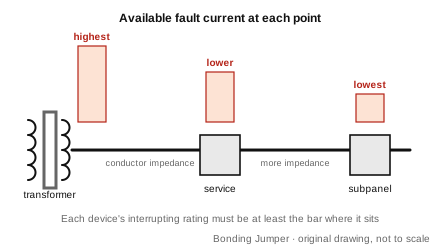
Use this diagram
What sets it
A bolted fault is as close to a perfect short circuit as you get: a solid connection with almost no resistance of its own. With the load gone, the only thing holding the current back is the impedance of the path.
- The transformer. Its nameplate impedance, given as a percent, is the share of rated primary voltage that pushes full-load current through a shorted secondary. The lower the percent, the higher the fault current at its terminals.
- The conductors. Each run between the transformer and the point you care about adds impedance. The fault current at a subpanel is lower than at the service, and lower again at the end of a long branch circuit.
- The utility source. A quick estimate treats the source feeding the transformer as unlimited. Real sources are not, so that estimate is an upper limit for the transformer terminals.
A worked example with invented numbers
A single-phase transformer is rated 48 kVA with a 240 volt secondary and a nameplate impedance of 2.5%.
- Full-load current: 48,000 ÷ 240 = 200 amperes.
- Percent to decimal: 2.5% is 0.025.
- Fault current at the terminals with an unlimited source: 200 ÷ 0.025 = 8,000 amperes. Dividing by 0.025 is the same as multiplying by 40, so 200 x 40 = 8000.
Now give the same transformer a 5% impedance. 200 ÷ 0.05 is the same as 200 x 20 = 4000, so 4,000 amperes. Double the percent impedance and the fault current halves. For a three-phase transformer, find full-load current from kVA ÷ (volts × 1.732) first, then divide by the impedance in the same way.
Try one question
Question 1 of the free 10-question check on TX Master. No signup. Then ask Lug, the AI study assistant, why the answer is right and the others are wrong.
Electrical Wiring Methods and Electrical Materials
Four conductors of the same size and insulation are pulled into a 20-ft run of conduit. What is the maximum percentage of the conduit's cross-sectional area they may fill?
Press A-D or 1-4 to choose an answer while this question is on screen.
Choose an answer to begin
Why it matters: interrupting rating
Every fuse and breaker has two different ratings. Its ampere rating sets the current it trips at and protects the conductor. Its interrupting rating is the largest fault current it can open safely. Under the overcurrent protection rules, the interrupting rating must be at least the fault current available where the device is installed, or the device can fail violently.
OSHA's electrical rules for general industry workplaces set the same requirement. 29 CFR 1910.303(b)(4) requires equipment meant to interrupt fault current to have an interrupting rating that covers the circuit voltage and the current available at its line terminals. 1910.303(b)(5) has the protective devices, the total impedance and the short-circuit current ratings of the components chosen together, so a fault clears without extensive damage.
With the example above, a device with an invented 5,000 ampere interrupting rating would be fine on the 5% transformer (4,000 amperes available) and not enough on the 2.5% one (8,000 amperes available).
Common mix-ups
- Thinking a higher percent impedance means more fault current. It means less.
- Using full-load current as the fault current. Full-load current is what the transformer delivers in normal use. Fault current is many times higher.
- Checking the breaker's ampere rating instead of its interrupting rating. A 20 ampere breaker can sit where thousands of amperes are available, if its interrupting rating covers them.
- Forgetting to convert the percent. 2.5% is 0.025, not 2.5.
- Assuming the number is the same everywhere. It falls with every run of conductor away from the transformer.
On the Texas exam
The PSI bulletin lists fault current in services, service equipment and separately derived systems, an NEC Knowledge area worth 11 scored items for master and 6 for journeyman. The same area in the master Calculations portion, worth 8, covers transformers.
Practice it
The transformer calculator gives full-load current from kVA on each side; divide its result by the percent impedance as a decimal to get the terminal fault current. Every term in this set is in the electrical terms glossary.
Sitting a master exam on the 2023 NEC outside Texas? Start with the master electrician exam outline or take the free NEC master check.
Know the idea? Take the free 10-question check
Take the free 10-question check for the Texas master exam. It needs no signup and explains every answer, so you see whether services, transformers or motors cost you the most points.
Not affiliated with or endorsed by TDLR, PSI or NFPA. NEC and National Electrical Code are registered trademarks of NFPA.
Ask Lug before you buy AI your AI study assistant
See what's on the TX Master exam, test yourself with 5 quick questions, or find the plan that fits you.
The TX Master course
Available now · instant accessLearn the subject areas the exam tests most, then prove it on a timed practice exam in the two-portion format.
- 10modules of lessonsEvery task on the outline
- 1timed practice exams72 questions in 232 minutes
- 192practice questionsEach one explained
- 1week-by-week study planSet to your exam date
Turn a practice answer into a study step. In untimed practice, ask Lug AI about any question you answer, follow up, then see your weakest topics and what to drill next.
Instant access. Terms and refunds · Secure checkout by Stripe · Billed by Nori Software
Every answer comes with a full explanation.
Sources
Show the list
- Candidate Information Bulletin, Texas electricians (updated 9/15/2026), PSI for the Texas Department of Licensing and Regulation. Checked 15 Nov 2026.
- 29 CFR 1910.303, General (electrical), Electronic Code of Federal Regulations. Paragraphs (b)(4) and (b)(5). Checked 15 Nov 2026.
- Lessons In Industrial Instrumentation, Tony R. Kuphaldt, section 5.4.4, Transformer impedance. Checked 15 Nov 2026.
- NFPA 70, National Electrical Code (2026 edition), NFPA. Free read-only access with an account. Checked 15 Nov 2026.
Bonding Jumper editorial team
Facts come from the sources listed above. If something has changed, tell us and we will correct it.
Your next step
Ready to see where you stand on TX Master?
Free, untimed and scored by domain. No signup.
Start the free 10-question checkTexas Master course. Lessons, timed practice exams and a plan around your exam date. Get Texas Master course · $149 See the plans or read the free sample lesson.Terms and refunds
Want a timed run? Take the free 25-question practice test (about 74 minutes). No email needed.
Prefer paper? Free printables
- Print a class quiz (free PDF). 10 practice questions with an answer key on page 2.
- Print the flashcards as cut-out cards (free PDF). The free flashcard sample, ready to cut and carry.