Separately derived system: what it means for the Texas exam
A separately derived system is a power source on the premises, most often a transformer, whose output circuit conductors have no direct connection to the circuit conductors that feed it. Only the grounding and bonding path ties the two together. Because its neutral is new, it needs its own neutral-to-ground bond and its own grounding electrode conductor.
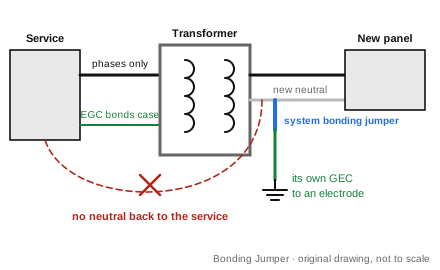
Use this diagram
How to spot one
Ask one question: is the neutral on the load side the same conductor that runs back to the service? Take a common dry-type transformer with a 480 V delta primary and a 208Y/120 V wye secondary. The primary is fed by phase conductors and an equipment grounding conductor, with no neutral at all. The secondary neutral is created at the wye point inside the transformer. Nothing but the bonding path connects the two sides, so the secondary is a separately derived system. The transformer calculator works out the current on each side of a unit like this.
A standby generator can go either way. When its transfer switch also switches the neutral, the generator's neutral is its own and the generator is a separately derived system. When the transfer switch leaves the neutral solidly connected, the generator shares the service neutral and is not one.
What it needs
- A system bonding jumper. It joins the new neutral to the equipment grounding conductors and the enclosure at one point only: at the source or at the first disconnect, never both. It does the job the main bonding jumper does at the service.
- A grounding electrode conductor. It runs from the new system to a grounding electrode, so the derived system is tied to earth the way a service is. See EGC vs GEC for how that conductor differs from the equipment ground.
- Its own protection. Overcurrent protection for the transformer itself has its own rules in Article 450, and the conductors from the secondary to the panel are feeder conductors. See feeder vs branch circuit.
Try one question
Question 1 of the free 10-question check on TX Master. No signup. Then ask Lug, the AI study assistant, why the answer is right and the others are wrong.
Electrical Wiring Methods and Electrical Materials
Four conductors of the same size and insulation are pulled into a 20-ft run of conduit. What is the maximum percentage of the conduit's cross-sectional area they may fill?
Press A-D or 1-4 to choose an answer while this question is on screen.
Choose an answer to begin
Why the bond matters here
When a hot conductor on the secondary side touches a metal box, the fault current has to get back to the transformer's secondary winding, not to the utility. The system bonding jumper is the only low-impedance way across from the equipment grounding path to that winding. Leave it out and the fault current has no good path home, the breaker may not trip and the metal stays energized. The equipment grounding conductor on the primary side bonds the transformer case, but it cannot do this job for the secondary.
Common mix-ups
- Skipping the bond because the primary has an EGC. The primary EGC bonds the case. Only the system bonding jumper gives secondary faults a way back to the winding.
- Bonding at the transformer and again in the panel. Two bonds put normal neutral current on the grounding path, the same problem as bonding the neutral in a subpanel.
- Assuming every generator is one. It depends on whether the transfer switch switches the neutral.
- Running the service neutral to the transformer. A delta primary has nowhere to land it, and the secondary needs its own neutral anyway.
On the Texas master exam
The PSI bulletin names separately derived systems in a subject area title: services, service equipment and separately derived systems. It carries 19 scored items on the master exam, 11 on NEC Knowledge and 8 on Calculations, and lists transformers and grounding and bonding inside it. The same area carries 10 scored items on the journeyman exam. Study to recognize a derived system, name its bond and its GEC, and turn to Article 250 for the grounding rules and Article 450 for the transformer.
Sitting a master exam on the 2023 NEC outside Texas? Start with the master electrician exam outline or take the free NEC master check.
Practice it
Every term in this set is in the electrical terms glossary.
Know the terms? Take the free 10-question check
Take the free 10-question check for the Texas master exam. It needs no signup and explains every answer, so you see which master subject areas cost you the most points. Studying for the journeyman exam instead? Take the journeyman check.
Not affiliated with or endorsed by TDLR, PSI or NFPA. NEC and National Electrical Code are registered trademarks of NFPA.
Sources
Show the list
- Candidate Information Bulletin, Texas electricians (updated 9/15/2026), PSI for the Texas Department of Licensing and Regulation. Checked 14 Nov 2026.
- NFPA 70, National Electrical Code (2026 edition), NFPA. Free read-only access with an account. Checked 14 Nov 2026.
Ask Lug before you buy AI your AI study assistant
See what's on the TX Master exam, test yourself with 5 quick questions, or find the plan that fits you.
The TX Master course
Available now · instant accessLearn the subject areas the exam tests most, then prove it on a timed practice exam in the two-portion format.
- 10modules of lessonsEvery task on the outline
- 1timed practice exams72 questions in 232 minutes
- 192practice questionsEach one explained
- 1week-by-week study planSet to your exam date
Turn a practice answer into a study step. In untimed practice, ask Lug AI about any question you answer, follow up, then see your weakest topics and what to drill next.
Instant access. Terms and refunds · Secure checkout by Stripe · Billed by Nori Software
Every answer comes with a full explanation.
Bonding Jumper editorial team
Facts come from the sources listed above. If something has changed, tell us and we will correct it.
Your next step
Ready to see where you stand on TX Master?
Free, untimed and scored by domain. No signup.
Start the free 10-question checkTexas Master course. Lessons, timed practice exams and a plan around your exam date. Get Texas Master course · $149 See the plans or read the free sample lesson.Terms and refunds
Want a timed run? Take the free 25-question practice test (about 74 minutes). No email needed.
Prefer paper? Free printables
- Print a class quiz (free PDF). 10 practice questions with an answer key on page 2.
- Print the flashcards as cut-out cards (free PDF). The free flashcard sample, ready to cut and carry.